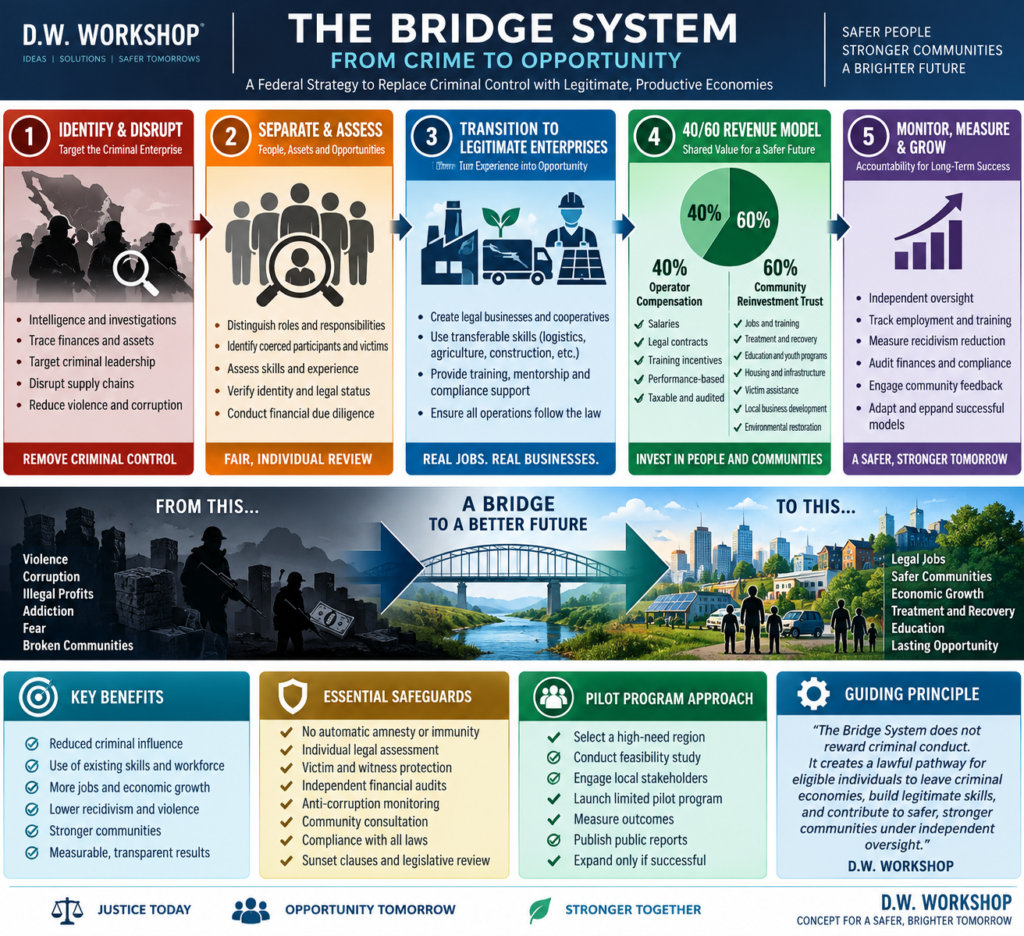
THE BRIDGE SYSTEM
A Lawful Federal Enterprise-Transition Strategy for Disrupting the Illegal Drug Economy
A conceptual framework for dismantling criminal ownership structures, redirecting lawful economic opportunity, and investing in safer communities.
1. Executive Summary
D.W. Workshop proposes examining the illegal drug trade through the analogy of a corporate takeover of a criminal industry.
The federal government would not purchase, endorse, or continue the illegal drug business. Instead, the proposed strategy would seek to dismantle criminal ownership structures and replace them with lawful economic opportunities, public-health services, employment, and community development.
Disrupt
Target criminal financing, leadership, supply chains, corruption, and money-laundering systems through lawful investigations.
Separate
Distinguish criminal organizers from coerced participants, victims, families, and individuals seeking to leave the criminal economy.
Transition
Create voluntary pathways into legitimate employment, education, training, and approved business participation.
Reinvest
Direct lawful public resources and recovered assets toward treatment, prevention, jobs, infrastructure, and community safety.
2. The Corporate-Takeover Analogy
The illegal drug trade can be examined as an interconnected enterprise ecosystem involving financing, production, transportation, warehousing, distribution, recruitment, territorial control, corruption, and money laundering.
In this model, the government would act as a law-enforcement authority, a legally authorized administrator or receiver where applicable, a public trustee of recovered assets, and a coordinator of lawful economic transition.
The analogy must not be used to justify unlawful confiscation, collective punishment, or the preservation of criminal power under a new administrative label.
3. Existing Personnel and Transferable Skills
People involved in the illegal drug trade should not automatically become employees or managers of a government-backed enterprise. Some may have participated in violence, trafficking, coercion, exploitation, or other serious offenses. Others may have been victims or limited participants.
After independent legal review, certain individuals may possess transferable skills that can be redirected into lawful industries.
Potential Skills
- Vehicle maintenance
- Logistics and transportation
- Agriculture
- Construction
- Accounting
- Warehousing
- Mechanical repair
- Food preparation
- Communications
- Local market knowledge
Eligibility Review
- Identity verification
- Individual legal assessment
- Beneficial-ownership checks
- Financial due diligence
- Assessment of coercion or exploitation
- Confirmation that criminal activity has ceased
- Required training
- Independent monitoring
No automatic employment, immunity, amnesty, or management privileges would be provided.
4. Enterprise-Transition Structure
Disrupt and Secure
Conduct lawful investigations, trace financial assets, collect evidence, identify criminal leadership, protect witnesses, and use court-authorized asset procedures.
Separate the Criminal Enterprise
Distinguish financiers, violent organizers, corrupt facilitators, coerced participants, victims, families, and individuals seeking lawful reintegration.
Build Legitimate Enterprises
Where lawful and economically viable, support agriculture, construction, transportation, renewable energy, food processing, technology, manufacturing, and community-owned businesses.
5. Potential Benefits
Reduced Criminal Dependence
Realistic employment and training opportunities may reduce economic pressure that contributes to criminal recruitment.
Use of Transferable Skills
Legitimate industries may benefit from properly screened experience in logistics, maintenance, agriculture, transportation, and operations.
Improved Prevention
Voluntary participants may provide lawful information about recruitment, coercion, financial exploitation, and community vulnerabilities.
Community Development
Resources could support jobs, apprenticeships, housing, youth programs, treatment, education, and local entrepreneurship.
Measurable Accountability
Programs could track employment retention, recidivism, training completion, tax compliance, treatment access, and community investment.
6. The Hypothetical 40/60 Model
D.W. Workshop previously explored a hypothetical 40/60 structure. This must not be interpreted as a division of drug profits between criminal organizations and government officials.
40% — Lawful Operator Compensation
- Documented salaries
- Approved contract payments
- Training-related compensation
- Lawful business participation
- Performance-based legal incentives
Payments would be documented, taxable where applicable, and independently audited.
60% — Community Development Trust
- Employment programs
- Treatment and recovery services
- Housing and education
- Youth prevention
- Victim assistance
- Infrastructure
- Local entrepreneurship
- Environmental restoration
The allocation is hypothetical and would require independent economic and legal analysis.
7. Community Reinvestment Dividend
D.W. Workshop proposes using the term Community Reinvestment Dividend instead of “welfare cheque.”
The concept would describe a lawful, transparent, milestone-based benefit tied to measurable public value—not an unconditional payment or a reward for past criminal conduct.
Possible Conditions
- Completion of vocational training
- Verified employment
- Business compliance
- Mentorship participation
- Voluntary recovery-support goals
- Community-service commitments
- No ongoing criminal activity
Purpose
Support long-term lawful participation by linking benefits to training, employment, compliance, reintegration, mentorship, and measurable community outcomes.
8. Presidential and Federal Authorities
A president or federal executive could potentially support portions of this concept through lawful measures, subject to constitutional, statutory, and jurisdictional limits.
Possible Actions
- Direct agencies to study organized-crime economics
- Coordinate law-enforcement and public-health departments
- Propose legislation
- Request legislative appropriations
- Establish interagency task forces
- Support legally authorized pilot programs
- Order program evaluations
- Expand lawful financial-intelligence cooperation
Legal Boundaries
- Constitutional protections
- Property rights
- Judicial review
- Legislative appropriations
- Due process
- Privacy laws
- Anti-corruption rules
- International obligations
- Federal and regional jurisdiction
A president could not lawfully convert criminal organizations into government contractors by executive order alone.
9. Policy Ideas Relevant to the Concept
Follow the Money
Financial investigations, asset tracing, and lawful forfeiture can weaken criminal enterprises. The Bridge System adds a proposed post-disruption economic-replacement component.
Public Safety and Public Health
Prevention, treatment, recovery support, harm reduction, and enforcement can be considered together with lawful employment and enterprise-transition services.
Target Criminal Structures
Policy research has examined how broad suppression can create unintended consequences, including displacement and violence. Any new strategy would require evidence-based evaluation.
Independent Evaluation
Researchers independent of program operators should assess results against a baseline and compare the model with alternative approaches.
10. Required Safeguards
Legal and Financial
- No blanket amnesty
- No automatic immunity
- No unlawful use of criminal proceeds
- Beneficial-ownership verification
- Anti-money-laundering controls
- Independent financial audits
- Judicial oversight
Human Rights and Community
- Victim and witness protection
- Whistleblower protections
- Voluntary participation
- No coercive recruitment
- Community consultation
- Privacy safeguards
- Independent complaints procedures
Institutional Independence
- No personal enrichment by public officials
- Police and prosecutors remain independent
- Labor and environmental compliance
- Anti-corruption monitoring
- Public reporting
- Sunset clauses
- Legislative review
11. Proposed Pilot Program
D.W. Workshop recommends beginning with a limited research and demonstration project rather than a nationwide implementation.
- Select one region with documented organized-crime and economic vulnerabilities.
- Conduct an independent feasibility study.
- Map lawful economic opportunities in the region.
- Consult local governments, Indigenous communities, service providers, businesses, victims, and residents.
- Establish a legally independent oversight body.
- Create voluntary workforce-transition services.
- Fund legitimate employers and training providers.
- Establish measurable performance indicators.
- Publish periodic public reports.
- End or redesign the program if evidence does not demonstrate public benefit.
12. Core Principle
13. Final Assessment
The D.W. Workshop concept proposes a shift in emphasis: from merely attempting to suppress an illegal industry to dismantling its criminal ownership structures and building legitimate economic alternatives.
Core Components
- Financial disruption
- Law enforcement
- Public health
- Workforce development
- Community reinvestment
- Independent accountability
Major Risks
- Corruption
- Wrongful asset seizure
- Criminal capture of legitimate businesses
- Coercion
- Conflicts of interest
- Creation of a replacement cartel
The proposal should be presented to presidential authorities as a research-based policy framework for lawful economic transition, not as an immediate operational order.