Golden Horseshoe
Trade Matrix
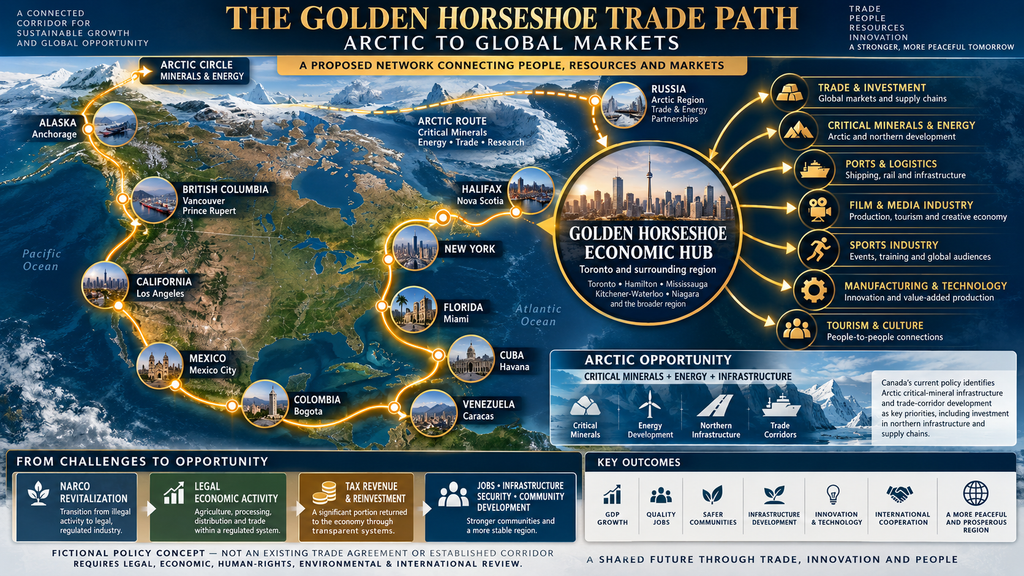
A conceptual framework for connecting cities, border communities, businesses and investment through modern trade channels, cloud-based coordination and regional economic development.
An Economic Development Trade Channel
The Golden Horseshoe Trade Matrix explores a new way of thinking about regional economic development in the 21st century.
The concept is to connect cities, businesses, border communities and investment opportunities through an integrated economic network supported by modern cloud technology.
Rather than treating borders only as dividing lines, the Matrix explores how border communities can become economic bridges between neighboring regions and countries.
The Golden Horseshoe provides a template for examining how trade, tourism, investment and business development could be coordinated across a regional economic corridor.
The border remains. The laws of each country remain. National security remains. But economic opportunity can be connected through bridges rather than isolated communities.
Explore The Trade Matrix
1. How Does The Trade Matrix Work?
The Golden Horseshoe Trade Matrix is designed as a conceptual economic-development channel connecting regional communities.
Businesses can use modern cloud-based systems to communicate, coordinate projects, manage information and develop partnerships across geographic boundaries.
The objective is to connect economic activity that already exists while creating opportunities for new investment, tourism, employment, production and trade.
In this model, the Golden Horseshoe becomes a template that other border regions could study and adapt to their own circumstances.
2. Regional Connections & Trade Channels
Connecting Regional Hubs
A trade channel is more than a route for moving products. It connects businesses, workers, consumers, investment, tourism, infrastructure and services.
The Matrix explores how neighboring cities and border communities could participate in a broader regional economic network.
Modern cloud technology creates additional opportunities for businesses to coordinate activities without requiring every participant to operate from the same physical location.
The Economic Corridor
The proposed corridor can be viewed as:
CITY → BORDER COMMUNITY → BUSINESS → INVESTMENT → TOURISM → TRADE → JOBS → COMMUNITY GROWTH
3. Economic Sectors
The Matrix is designed around multiple economic sectors rather than depending on one industry.
Film & Entertainment
Expand film production, music, digital entertainment, creative businesses and production services.
Sports
Expand sporting events, tournaments, athletic programs, facilities and sports-related tourism.
Tourism
Develop connected tourism experiences that encourage visitors to explore communities across the economic corridor.
Clean Infrastructure
Create infrastructure opportunities supporting transportation, energy, technology, communications and long-term community growth.
Agriculture
Expand agricultural production, processing, technology, food systems and regional agricultural trade.
Business Development
Connect entrepreneurs, established businesses, investors and community development opportunities.
4. Human Investment & Community Empowerment
Education Empowerment
Economic development requires people with the skills and knowledge to participate in new opportunities.
Family Security
Community development can include opportunities that support employment, housing, education and family stability.
Child Safety
Child safety can be treated as a fundamental community priority alongside economic development.
Empowered Healthcare
Healthcare infrastructure, technology, services and community programs can become part of broader regional investment.
5. Governance, Security & Trust
A connected economic corridor requires transparent rules and clearly defined responsibilities.
The conceptual framework therefore includes transparent accounting, legal oversight, independent monitoring and appropriate security protections.
Any real-world implementation would require agreements between the relevant governments, businesses and communities and would remain subject to the laws and security requirements of each participating country.
6. Partnership & Investment Structure
One conceptual approach is to create a partnership structure in which private businesses and public institutions participate in clearly defined roles.
A proposed two-part structure could separate ordinary business development from government security and border responsibilities.
Business Development
Private-sector partners would focus on business development, staffing, investment, production, tourism, trade and economic growth.
Public Security Responsibilities
Government authorities would retain responsibility for border integrity, enforcement, public safety and applicable security functions.
7. Economic Revitalization & Reinvestment
The broader conceptual model examines whether economic revitalization strategies could redirect resources toward lawful businesses, employment, infrastructure and community investment.
Within the fictional framework, revenues generated through lawful economic activity could be considered for reinvestment into participating communities.
Any real-world funding mechanism would require legislation, public accountability, independent oversight and compliance with applicable national and international law.
8. From Economic Activity To Community Growth
The economic cycle can be represented as five connected stages.
Economic Activity
Business and production.
Revenue Generation
Sales, exports and employment.
Accountable Taxation
Lawful tax collection.
Strategic Investment
Infrastructure and programs.
Reinvestment
Community growth.
9. The 21st Century Opportunity
The Golden Horseshoe Trade Matrix asks a fundamental question:
What could regional economic development look like when cities, businesses and communities are connected digitally as well as geographically?
The concept explores an economy in which physical borders continue to protect the integrity of nations while technology creates new bridges for lawful economic cooperation.
It is a framework for examining how trade, tourism, investment, infrastructure, entertainment, agriculture, sports and human development might work together as parts of one connected regional economy.