NARCOTICS REVITALIZATION PROGRAM
FROM CONFLICT CROPS TO GLOBAL SOLUTIONS
SECURE REGIONS • RESTORE COMMUNITIES • SAVE LIVES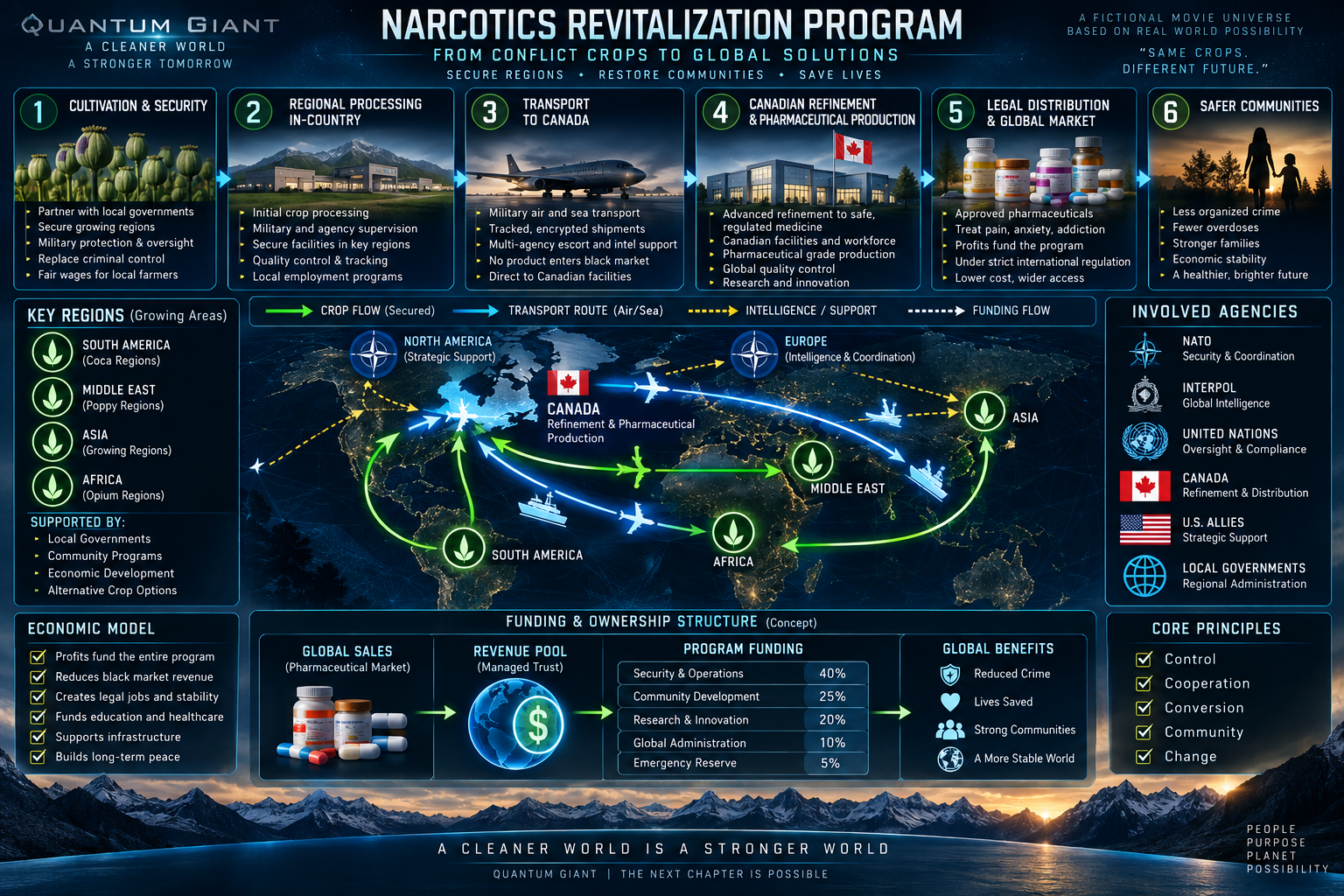
THE MASTER PLAN
From conflict crops to global solutions
THE GLOBAL FLOW
Transport • Refinement • Distribution
THE HUMAN IMPACT
Distribution • Community benefits • A safer world
THE THREE-PART SYSTEM
Sourcing • Transport • Global impact
THE BIGGER PICTURE
Global systems • Funding • Future possibilities
FICTIONAL CONCEPT ART • FOR SCREENPLAY DEVELOPMENT AND STORYTELLING
Operation: Second Harvest
GLOBAL SECURITY DIRECTORATE
PRELIMINARY INTELLIGENCE ASSESSMENT
A Discovery That Changes the Case
What began as an investigation into international narcotics trafficking has uncovered a proposed economic and geopolitical architecture with implications far beyond the original case.
During the examination of recovered documents, investigators discovered three interconnected diagrams outlining a proposed global crop-conversion and pharmaceutical-financing initiative.
The documents describe a system in which selected regions could transition away from criminally controlled crop economies and participate in a regulated agricultural and pharmaceutical supply chain.
THE PROPOSED OBJECTIVE
- Support alternative economic opportunities.
- Reduce criminal control over agricultural regions.
- Establish regulated processing and distribution.
- Generate lawful commercial revenue.
- Finance community development initiatives.
THE CENTRAL QUESTION
Who designed the alternative economy—and who would control the system that replaces the existing narcotics network?
Investigators have yet to establish whether the proposal represents a genuine humanitarian vision, a commercial enterprise, or a component of a larger hidden operation.
— Fictional investigator’s field note
The Three-Stage Architecture
Analysts have designated the recovered material “The Three-Stage Architecture.” The documents combine agricultural development, security coordination, pharmaceutical production, and financial planning into one proposed international system.
DOCUMENT A
Crop Sourcing & Security
The proposed foundation: transitioning selected growing regions toward regulated agriculture and community-based economic development.
DOCUMENT B
Transport & Refinement
The proposed international supply chain, including authorized transfers, Canadian processing, and pharmaceutical manufacturing.
DOCUMENT C
Distribution & Impact
The promised outcomes: regulated medical products, lawful commercial revenue, and investment in communities.
UNRESOLVED ISSUE
The appearance of an institution or agency on a diagram does not establish its involvement or authorization.
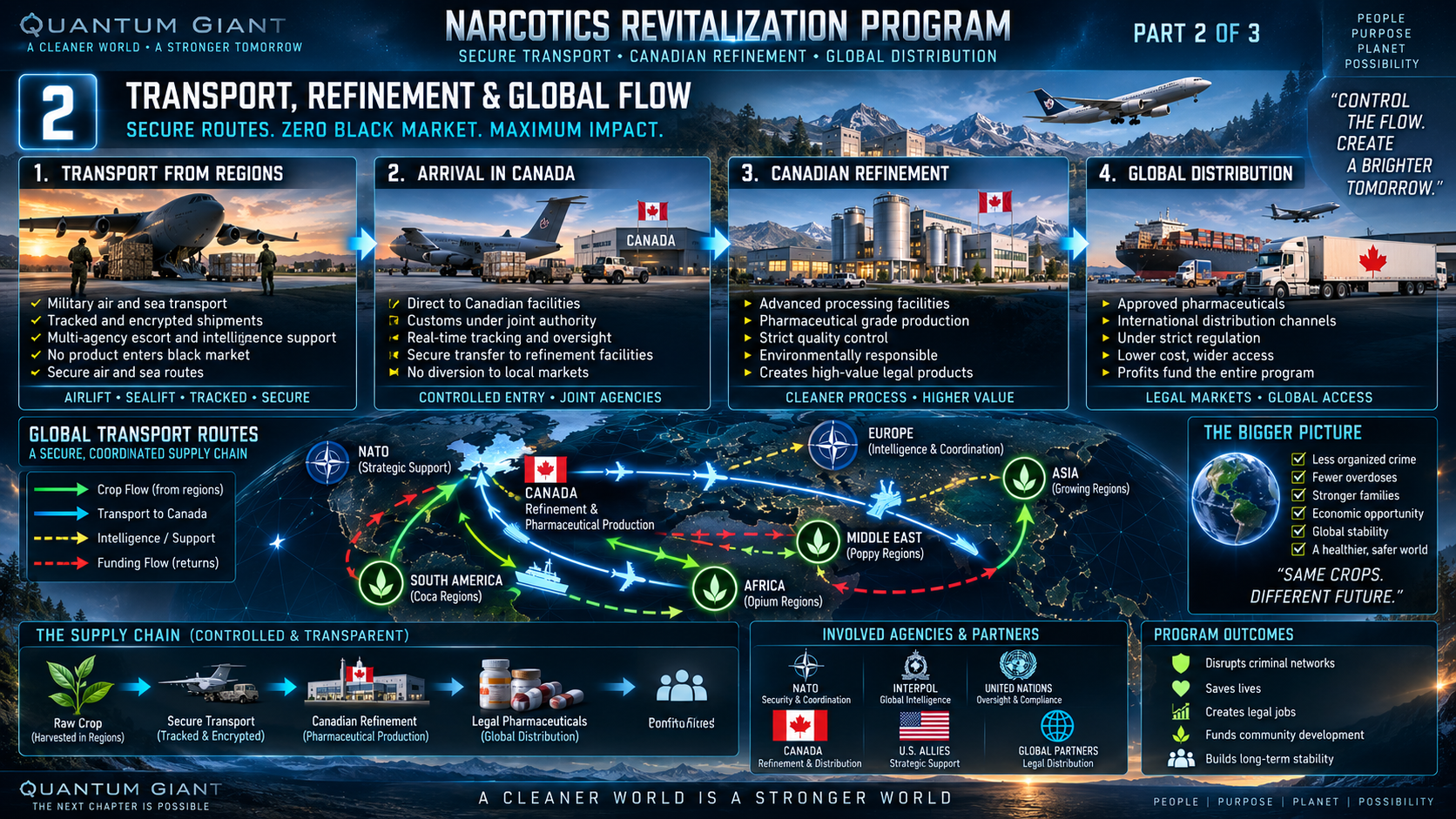
Crop Sourcing & Security
“The Ground-Level Conversion”
The first diagram depicts the proposed starting point of the initiative: regions where illicit crop economies have become connected to poverty, organized crime, corruption, and political instability.
What Investigators Believe the Diagram Shows
The concept proposes cooperation between local authorities, licensed agricultural workers, community programs, and authorized security institutions.
In the fictional plan, military bases are presented as institutional and logistical support hubs. Their proposed function is to support communications, authorized logistics, civilian protection, and coordination—not to replace civilian governance.
PROPOSED SECURITY ROLE
- Protect designated communities.
- Support lawful operations.
- Provide communications infrastructure.
- Support oversight and coordination.
- Prevent criminal interference.
REGIONAL FOCUS
- South America — fictional coca-growing regions.
- Middle East — fictional poppy-growing regions.
- Asia — alternative-development regions.
- Africa — economic transition initiatives.
The Investigative Question
Is the proposed security structure designed to protect communities—or could it become a mechanism for controlling valuable resources?
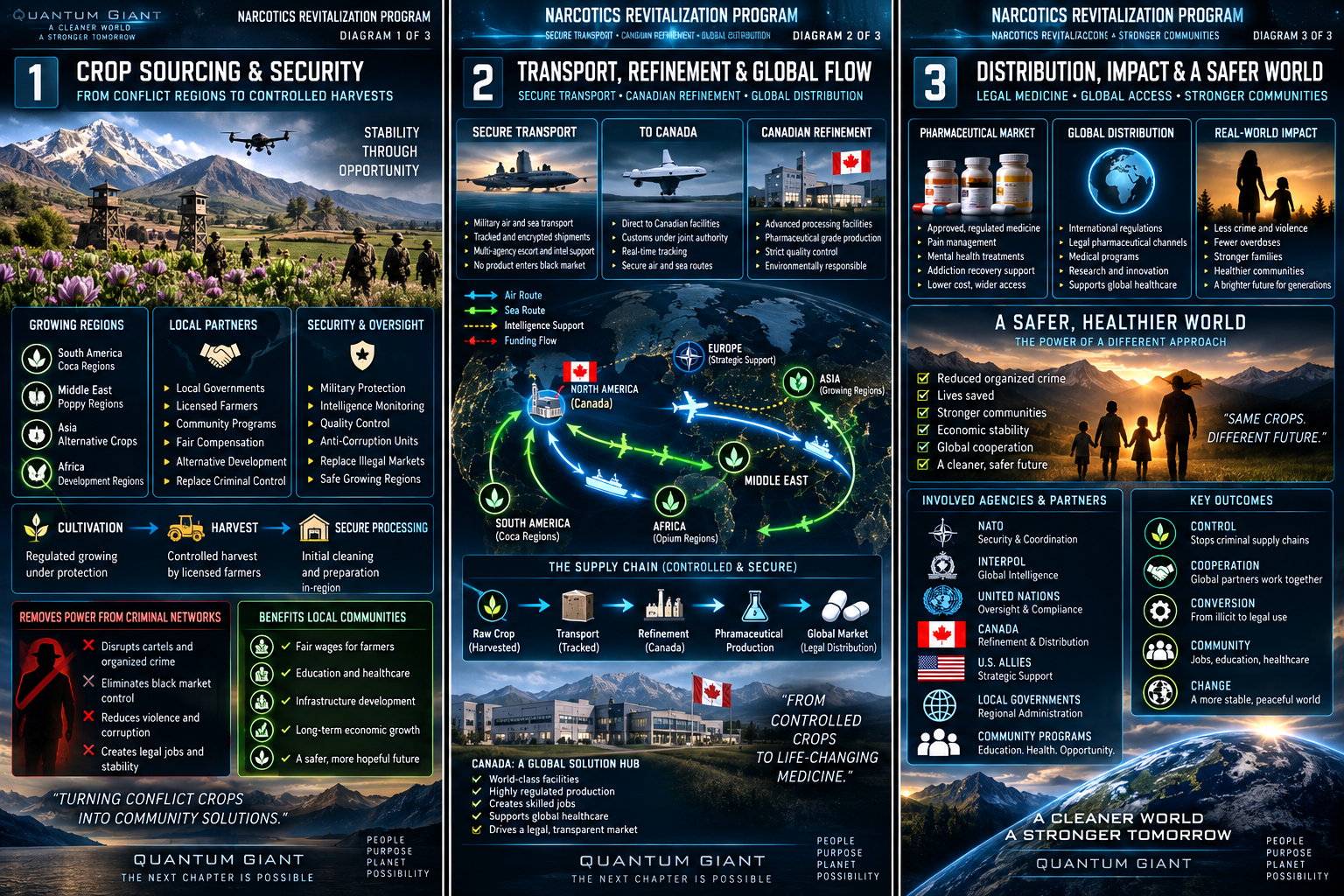
Transport, Refinement & Global Flow
“The Canadian Connection”
The second diagram reveals what analysts believe may be the economic engine of the entire proposal: the conversion of authorized agricultural materials into regulated pharmaceutical products.
The Four-Stage Model
01 — Regional Transfer
Participating regions would supply approved agricultural materials through a legally authorized system.
02 — Arrival in Canada
Canada is identified in the fictional proposal as a pharmaceutical processing and oversight hub.
03 — Pharmaceutical Refinement
Regulated facilities would conduct research, quality assurance, and the production of approved medical products.
04 — Global Distribution
Approved products would enter legitimate pharmaceutical and healthcare markets through authorized channels.
The Proposed Revenue Model
PROPOSED REINVESTMENT
Commercial revenue would be directed toward community development, healthcare, infrastructure, research, and administration of the fictional program.
Why the Discovery Alarms Investigators
The proposal combines international transportation, agricultural resources, military infrastructure, pharmaceutical manufacturing, and financial administration.
The investigators must determine who would own the facilities, who would authorize the products, and who would control the revenue pool.
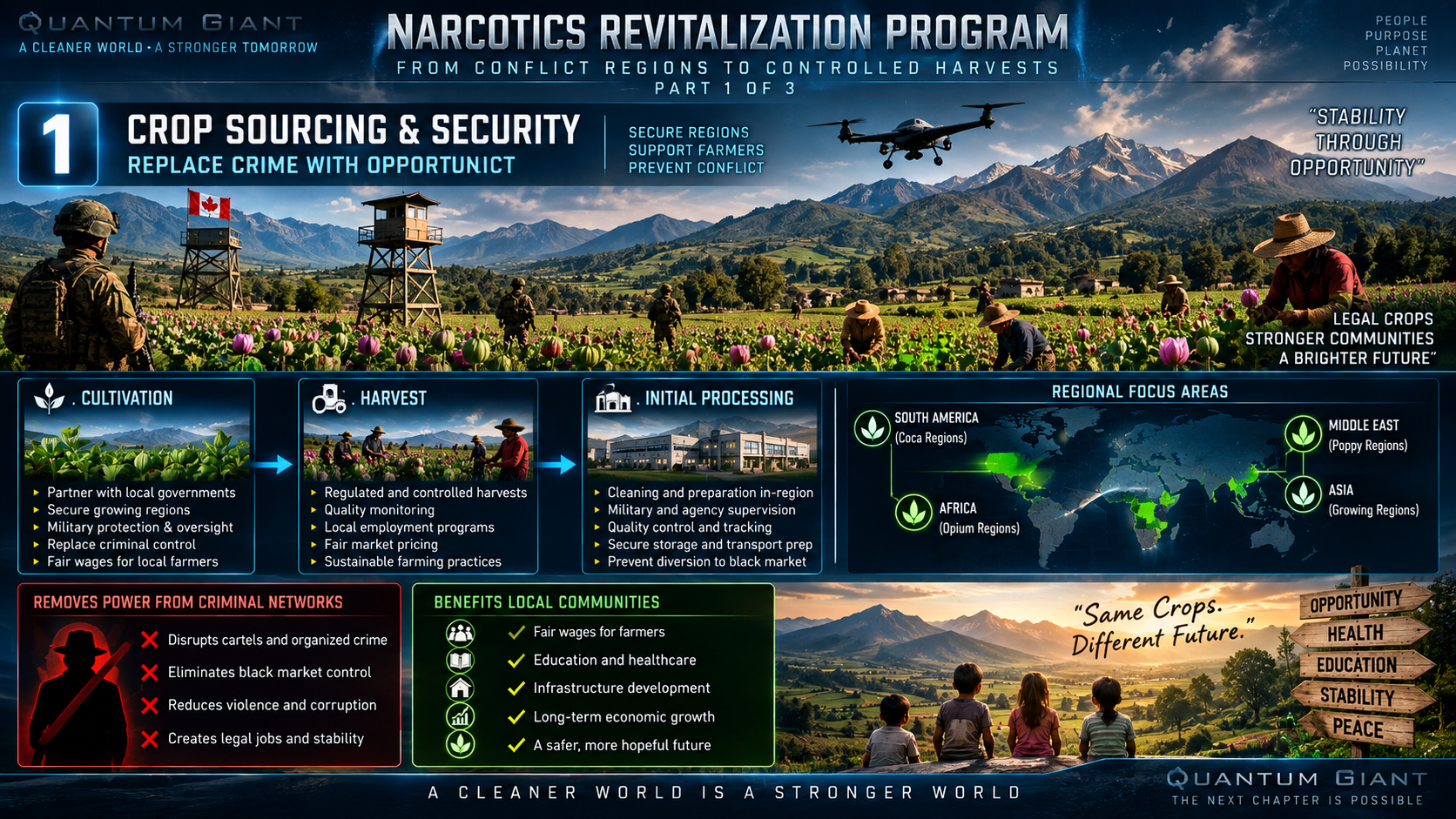
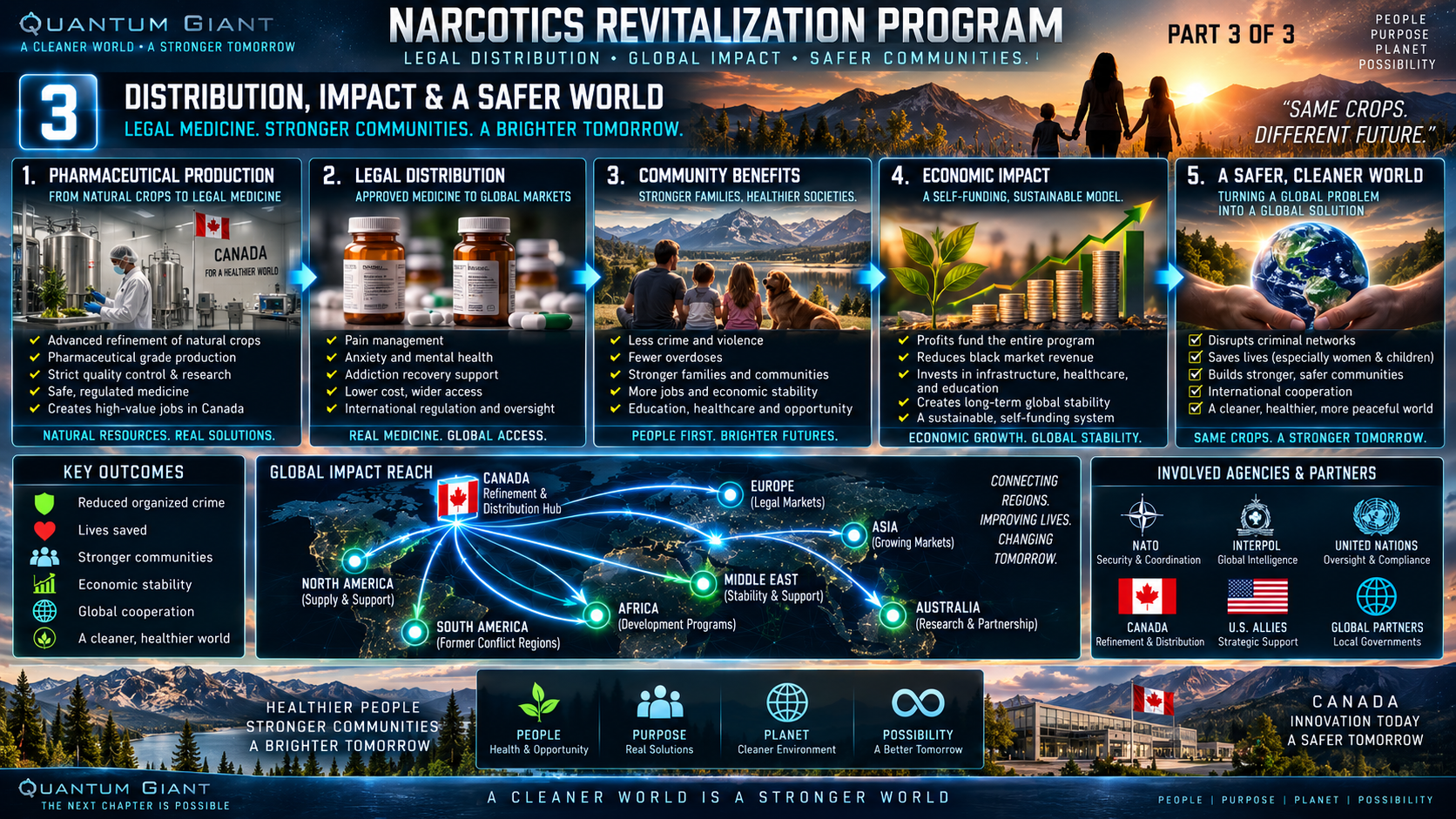
Distribution, Impact & A Safer World
“The Promise”
The third diagram presents the most ambitious part of the proposal: the possibility that lawful commercial revenue could support a worldwide program of economic and social development.
DISRUPT CRIMINAL SUPPLY CHAINS
Replace the economic incentives that sustain criminal control over selected agricultural regions.
PROTECT COMMUNITIES
Invest in healthcare, education, family support, and legitimate economic opportunities.
BUILD A SUSTAINABLE MODEL
Use legitimate commercial revenue to support the proposed initiative and participating communities.
INTERNATIONAL COOPERATION
Coordinate local governments, regulatory bodies, and authorized healthcare institutions.
The Contradiction at the Heart of the Plan
The same document promising a safer future also proposes an enormous international system involving military infrastructure, agricultural resources, pharmaceutical manufacturing, and financial administration.
It could represent a genuine humanitarian vision. It could also provide opportunities for corruption, political manipulation, or covert control.
The evidence does not yet establish which interpretation is correct.
— Fictional senior intelligence analyst
The Institutional Web
The documents reference several international institutions and partners. Investigators are attempting to determine whether these names reflect genuine involvement, proposed cooperation, or unauthorized use of institutional identities.
NATO
Depicted in the fictional documents as a possible security and coordination partner. No authorization is established.
INTERPOL
Referenced as a potential source of international intelligence cooperation. Participation is unconfirmed.
UNITED NATIONS
Shown as a possible oversight and compliance partner in the proposed architecture.
CANADA
Identified as the proposed pharmaceutical refinement, production, and distribution hub.
LOCAL GOVERNMENTS
Presented as key partners in agricultural transition and regional development.
COMMUNITY PROGRAMS
Proposed partners in healthcare, education, employment, and social development.
Unresolved Threats
The documents present a potentially transformative concept, but investigators have identified several unresolved risks.
01 — INSTITUTIONAL CAPTURE
Could powerful actors use the program to control land, resources, or revenue?
02 — CRIMINAL INFILTRATION
Could organized crime attempt to penetrate the new system or divert its resources?
03 — SOVEREIGNTY
Would participating governments retain control over their laws, land, and resources?
04 — FINANCIAL OPACITY
Could the proposed revenue structure conceal corruption, unauthorized payments, or a parallel financial network?
05 — HUMANITARIAN CONSEQUENCES
Could a poorly designed transition harm farmers, patients, or communities dependent on the existing economy?
06 — POLITICAL MANIPULATION
Could the humanitarian language of the plan conceal strategic objectives unrelated to public welfare?
The Scientist
The identity of the person who created the Three-Stage Architecture remains unknown. Preliminary investigators suspect that an unidentified scientist may possess knowledge of the proposal’s scientific and financial components.
THE ARCHITECT
The scientist designed the original concept and understands the complete structure.
THE CONSULTANT
The scientist provided technical expertise to another organization.
THE INTERMEDIARY
The scientist connected otherwise unrelated institutions and interests.
THE SCAPEGOAT
The scientist may have been framed to conceal the identity of the true organizers.
The central mystery is whether the scientist created a humanitarian alternative—or whether the program is part of a larger operation that investigators have yet to uncover.
Questions for the Next Chapter
The authorities must resolve the following questions before they can determine the true nature of the proposal.
The Investigation Remains Open
The Three-Stage Architecture depicts a proposed international system intended to transform the economic foundations of the narcotics trade into a regulated pharmaceutical enterprise.
Its stated objectives are humanitarian: reduce criminal influence, generate lawful revenue, create employment, and improve the lives of vulnerable populations.
Yet the scale of the proposed operation introduces unanswered questions involving sovereignty, institutional authority, financial accountability, and control of resources.
The discovery does not prove that a global conspiracy exists. It does, however, reveal a concept with the potential to unite— or divide—governments, corporations, criminal organizations, and the scientific community.