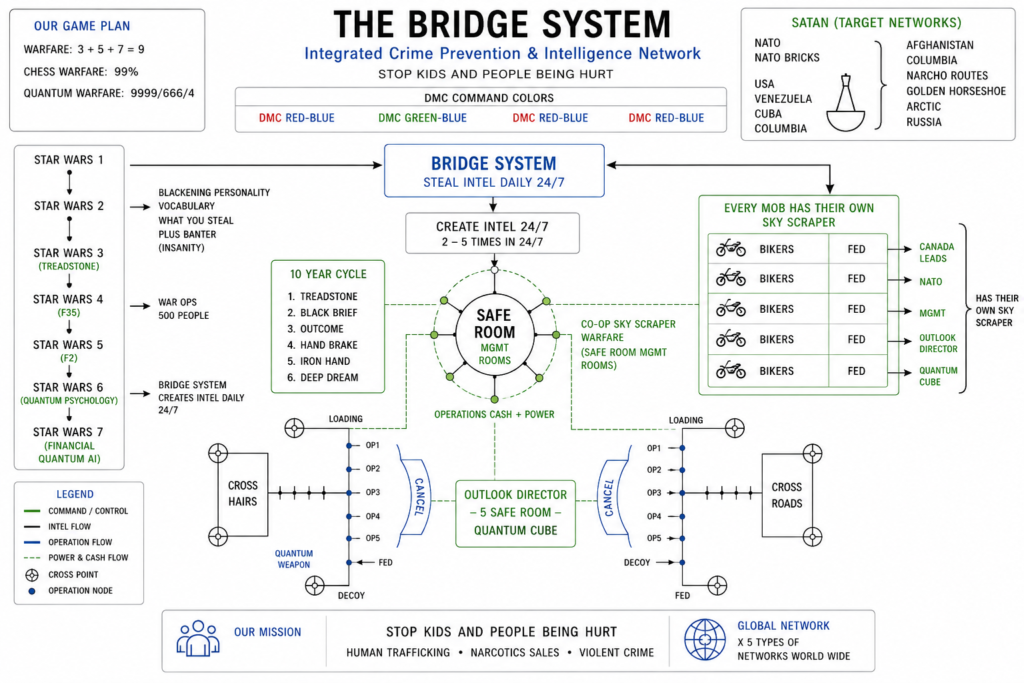
The simplest definition of the whole diagram is:
THE BRIDGE SYSTEM connects people, information and organizations so that warning signs can be recognized earlier, reviewed by qualified professionals, and turned into protective action before vulnerable people are harmed.
And I think that should be the fundamental technology behind your movie’s Cloud Security Plan.
CONFIDENTIAL // EYES ONLY // INTEL BRIEF
TO: Senior Command / Oversight
FROM: Strategic Architecture Assessment Division
DATE: August 29, 2026
SUBJECT: Technical Evaluation & Threat Analysis: The Bridge System (Project Architecture)
1. Executive Summary
The following brief provides a tactical assessment of The Bridge System, an integrated crime-prevention and intelligence network designed to aggregate multi-source data, map non-linear threat vectors, and execute preemptive interventions against high-harm criminal enterprises (specifically targeting human trafficking, narcotics exploitation, and violent crime).
Unlike conventional law enforcement databases, the architecture relies on distributed intelligence nodes, historical generational iterations, and multi-dimensional pattern recognition rather than centralized command-and-control surveillance.
2. Core Architectural Components
- The Bridge System (Central Node): Functions as the primary intake valve for continuous, 24/7 intelligence collection. Its mandate is pattern identification and human-verified routing rather than direct field enforcement.
- The Safe Room (Management Coordination): Operates as the protected operational core. It receives filtered threat streams from the Bridge System and manages resource allocation across diverse organizational structures.
- The Quantum Cube: Serves as the multi-dimensional data architecture. By evaluating intersections across people, places, time, events, and relationships, the system shifts query parameters from “Who is the criminal?” to “Are these apparently unrelated events connected?”
- Crosshairs & Crossroads: Dual-purpose operational mechanics. Crosshairs handles targeted focus on high-risk concentration points, while Crossroads maps complex intersections where disparate data streams cross paths.
3. Evolutionary Timeline (The 7-Generation Framework)
The system’s historical architecture reflects a decades-long evolutionary cycle divided into sequential technological generations:
- Generations 1–3 (Foundational & Treadstone Era): Basic data consolidation and structural security foundations.
- Generations 4–5 (War Ops & F35/F2 Integration): Incorporation of high-speed tactical feeds and secure communication grids.
- Generation 6 (Quantum Psychology & Security): Integration of advanced behavioral pattern recognition and quantum-secure data encryption.
- Generation 7 (Financial Quantum AI): Current operational state, mapping complex financial flows, global network topologies, and predictive threat analytics.
4. Operational Risk & Vulnerability Assessment
- Resilience Through Decentralization: Because no single agency controls the entire network—with data contributed across diverse operational groups, federal entities, and international frameworks—the architecture resists single-point-of-failure compromises.
- The “Loading” Bottleneck: Intelligence transfer between peripheral networks (Sky Scraper Operations, Outlook Director) and the central Safe Room creates momentary data bottlenecks during high-volume threat surges.
- Human-in-the-Loop Safeguards: Automated pattern matching is strictly throttled by mandatory human review protocols to prevent automated escalation or algorithmic over-reach.
5. Conclusion & Recommendation
The Bridge System represents a shift from reactive investigation to predictive, multi-agency threat mitigation. Continued deployment of its quantum architecture is recommended, subject to strict adherence to the foundational mandate: Stop kids and people being hurt.